
Fun and Games.

Many a time when I was growing up survival meant finding a distraction when things were starting to kick off. A number of these distractions have been mentioned at various points in this blog, and the most important was certainly books. Whether it was the feeling of slipping into the enchanted landscapes of J R R Tolkein, Tove Jansson or Robert E Howard, extracting much needed laughter from Asterix the Gaul, Nigel Molesworth or Johnny Hart's cavemen, or trying to follow the strategic and tactical twists and turns as David Chandler described Napoleon's ill-fated last campaign, the book was and remained such a constant and vital companion that I have always felt something of a sense of unease when parted from them for too long.
Another distraction, at least when at least one other person was present to share it, was the boardgame. Boardgames were such a large part of my life that, right up to my last Christmas as a child in Liverpool in 1977, the bulk of my Christmas presents would consist of them, with toys and annuals as an occasional outlier. And, when the inevitable Christmas row kicked off between my inevitably tipsy parents, all the still new boardgames provided such a potent distraction that it was all mere background noise, just something ones parents got up to, and on this occasion might safely be ignored while we explored the possible strategies - insofar as there were any - of the new haul of games.
While this blog regularly strays into the sort of dangerous rose-tinted territory where the past is seen as always best, this is decidedly not the case with boardgames. The huge variety of games available now, at a time when new games are published on a daily basis, make the fare available to us in my childhood seem like slender pickings indeed, and whenever I look up those old games on the BoardGameGeek website I can only agree with the generally very low scores they receive in comparison to the much more sophisticated games being released nowadays. My personal experience of boardgaming included a long hiatus between the late 1970s and the early twenty first century when my nephews had reached an age when they were becoming interested in boardgames, and I found the developments that had occurred in the design and production of games between the two dates nothing short of breathtaking.
My childhood was a time when the history of mass-produced commercially available board games was still quite young. The rise of the boardgame was very much a twentieth century phenomenon. At the end of the nineteenth century we mostly still had the ancient classics: chess, draughts, backgammon, tic tac toe, snakes and ladders - the last, rather charmingly, had begun life as an illustration of Buddhist spirituality, where participants embarked upon a life journey determined by the consequences of their virtues (ladders) and vices (snakes), the whole a comment upon the wheel of karma upon which we mortals rise and fall during our short stay here. Shortly before the end of the century, in 1896, there was a notable new entry to the canon when Alfred Coller patented his own brand based upon the ancient Indian game of Pachisi and called it Ludo.

The first major development boardgame-wise of the twentieth century was the publication in 1904 of a game called The Landlord's Game by the US feminist and socialist Elizabeth Magie. The game, like snakes and ladders previously mentioned, had an underlying earnestness in the sense that it was designed to illustrate a system of belief, in this case a progressive economic system known as Georgism (and I will speak no further on the subject of economics because I really don't understand it at all and have little desire to). The original game seems ambivalent on the merits of the system, including two sets of rules favouring two different styles of play, the one selfish and monopolistic and the other a more enlightened co-operative strategy - a bit like John Lennon's line in the song Revolution where he wants to be counted 'out...in...out' of any talk of destruction. The primary importance of The Landlord's Game is that three decades later another games developer, Charles Darrow, basically lifted it to provide the basis for the game Monopoly, which he later claimed to have totally invented, a claim to which most were glad to subscribe. Monopoly was quite different to its predecessor, the earnestness had disappeared and it was basically just a family game about beggaring your neighbour. Removing the didactic element was a smart move and the resulting game has of course proved a huge cultural icon and a vast goldmine, spawning literally thousands of branded variants that range from the Harry Potter and The Lord of the Rings films to just about every top flight football club on the planet. That particular horse will never quite give up the ghost no matter how often it is flogged.
Monopoly didn't figure very much in our gaming experience, partly I think because it was already regarded as a bit dull and vanilla by the time I started playing in family game events. It cast an influence however, reflected in several games I came to like very much including Careers, a slightly later (1955) game where each player set their own victory conditions as a balance of fortune (money), fame and happiness, and 1974's Hotel. Hotel was very reminiscent of Monopoly in the sense that the aim was to beggar one's opponents by building hotels in which they had to stay (and like Monopoly the underlying idea was robust enough to spawn numerous versions and reprints); it also brought to the table the very 1970's concept of games with a 3D content, i.e. games that contained things made of cardboard that stood upright on the board, of which more later.
The pace of boardgame development quickened in the 1950s with the release of a clutch of games that have come to be regarded as classics. These included Scrabble, Cluedo (Clue in the US), Diplomacy and Risk. Diplomacy is a historical game that covers the period leading up to the Great War and can lay some claim to being the first commercial 'wargame' - although somewhat different to most wargames in the sense that it is not turn-based, there is no random element to the combat and all of the few units that the game includes have equal value. One feature it shared with many of its successors was a long playing time; a full game of Diplomacy is unlikely to last less than a day and in fact I can only once ever remember having enough people in the same place for enough time to play a game (for this reason it became one of the world's first successful postal play games and is still perhaps best enjoyed when played by email with an umpire). It wasn't a game for me, alas. I found the backstabbing genuinely upsetting and was never clever or calculating enough to be able to backstab with the rest of them. There was also the fact that the heart of the game was the negotiation, and I have never been any good at all at negotiating, I just could never successfully weigh up my own needs against what I could safely offer to others and so I was always conceding far too much. My efforts at negotiation in wargames always reminded me of the Simpsons episode Bart The Genius where Bart allows himself to be duped out of his lunch by the smarter kids: "Hey Bart, I'll trade you the weight of a bowling ball on the eighth moon of Jupiter from my lunch, for the weight of a feather on the second moon of Neptune from your lunch."

Risk was a different beast altogether. Simpler than Diplomacy, and in fact simpler than most strategy games (it's no accident that it is paired with Twister in the lyrics of the REM song), it was essentially a big dicefest that became a gateway game into wargames for a whole generation. Its place in Carey family culture results from its being the most bitterly divisive game ever played. I don't remember a single game no matter what the mix of players that didn't end with somebody taking the invasion of their carefully built-up empire as a personal insult and upending the board and counters across the floor.

By the mid-1970s when I was getting at least half a dozen boardgames every Christmas there was a whole host of them to choose from with more coming out every year. Looking back they were mostly, like Risk, very heavily luck dependent, most with a roll and move mechanic that made them age quickly. It seems now that, unlike the later 90s/00s proliferation of new boardgames in which the designer sought to introduce new and innovative mechanics to make the game more interesting, many designers of the 70s fell back instead on easier and more gimmicky devices. I remember a whole slew of games in which the game relied on visible features that were often completely unnecessary to the gameplay. Thus we had the likes of Planet of the Apes (1974), a spin off from the TV series that was itself a spin off from the film whose main selling point was a cardboard jail with a trapdoor through which the human player pieces could be made to fall (as opposed to, say, just putting them in a marked area on the board); Ghost Train (also 1974) in which the circuit taken by the players runs across and around a series of cogs and the twist of a handle can completely reorientate the board while eliminating some of the players; or Newsdesk (1976), a strikingly tedious journalism-themed game in which players receive their assignments from a wholly unnecessary 'telex' machine that, again, was the main selling point of the game. A slightly tenser and more interesting gimmick was provided by 1973's The Fastest Gun, a western themed-game in which players often had to resort to gunfights to defend their property. The gunfights were fought in the centre of the board underneath which was a wheel with strategically placed holes, turning which would make one of the gunfighting figures fall, dead. A clever angle of this was that if you couldn't afford to hire a gunfighter to fight in your place you would have to put your own piece into the fight, and he would be compelled to take up his position closer than the more expensive gunfighters to the centre of the wheel where the holes were closer together, thereby making it more likely that he would lose the fight.

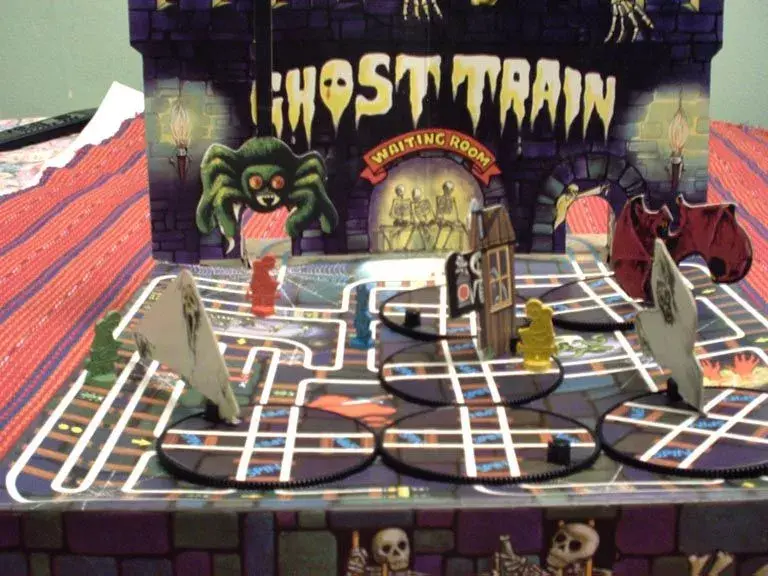

One benefit of the gimmicky game was that there were often more interesting components that could be used for other things. The jail from Planet of the Apes could be used for games of soldiers for example. My mate Carl had 1975's War of the Daleks, a fairly poor Dr Who spin-off that had no Dr Who counter but did have two small armies of very cool daleks which once again could be pitted against our Airfix soldiers. Both Haunted House and Mousetrap - a bizarre game in itself which consisted of slowly and tediously building the trap over half an hour just so that somebody got to activate it once the mouse was in place...how the hell did anyone win? - contained brightly coloured mouse pieces that somehow found their way into our various soldier games. A downside was that where there are more pieces there are more things that can go missing; not only that but moving parts on a game are something that can very easily break and render the game unplayable. This was all the more the case for games like Ghost Train or The Fastest Gun where the gimmick was effectively the board. It's striking how expensive those 70s games can be now on eBay or BoardGameGeek if they are in anything approaching good condition - we played with them pretty energetically and those gimmicky features were never sturdier than thin cardboard or brittle plastic.
There were always slightly more cerebral games running alongside the silly ghost trains and the tumbling cowboys. We had Mastermind that always disappointed initially because it was nothing to do with the TV quiz show; Quandary, a sneaky little game where the aim was to get your pawn to the other side of the board but you could only move it one space forward if the space to which it was moving was of the same color as the space in front of at least one of your opponents' pawns. Or Black Box, a game in which you tried to identify the position of atoms by 'firing' 'rays' represented by ball bearings into the eponymous black box and noting their course. I played these games and quite enjoyed them but as my main opponent was my older brother Mike, five years older and much cleverer than me, I rarely prevailed. In truth I preferred the games with a more obvious theme because of the narrative they provided. A major part of my enjoyment of games has always been the sense of a story emerging from them. and that is the reason why I still prefer a wargame, even if only a mediocre one, over a 'soulless Euro', be it ever so clever and innovative. I don't tend to prevail in the wargames either but luckily that isn't really something that bothers me as long as a good time is had and some kind of entertaining narrative emerges.
As mentioned earlier, I largely stopped playing games of any kind for more than two decades, between the late 1970s and the early 2000s and it was with a sense of amazement that I started playing again and realised how far board game design had come in the meantime - Settlers of Catan and Carcasonne and Small World seemed to effortlessly excel those poor simple games of my childhood with their silly gimmicks and unimaginative roll and move rules. But as with everything else they were of their time and it's still fun to remember those days post Christmasses past of constant gaming while munching chocolate and leftover turkey while somewhere in the background my parents fought. I doubt I'll ever play Risk or Mousetrap again if I live to be a hundred but they'll always have a place in the heart of an old gamer.


Comments