
Hauntings; The Stuff of our Nightmares
Updated: Sep 9
Reading about Hauntology, of which I have done a fair amount recently (see my last post), one is struck by the persistence of cultural themes associated with what we would tend to call folk horror.
Wikipedia's entry for folk horror defines it as "a subgenre of horror film and horror fiction that uses elements of folklore to invoke fear and foreboding. Typical elements include a rural setting, isolation, and themes of superstition, folk religion, paganism, sacrifice and the dark aspects of nature." It notes that the genre "usually focuses on the beliefs and actions of people, rather than the supernatural" although there are definitely some notable exceptions to this.
The genre's central position in Hauntology is unsurprising. As a philosophy it is distinctly Lapsarian, positing a point in recent time at which the promised futures of the postwar period were 'lost'. There is therefore a distinct 'before' and 'after', and the 'before' reaches out to 'haunt' our eternal present. The very weirdness of much of the old folk horror makes it much more haunting to those who grew up with it. Those stories seem to have at their heart an 'otherness' that feels alien to our noisy, fast, bright, crowded times where rural settings and isolation themselves are things that most of us can only dream of and where an interest in folklore is so niche it seems to be popularly regarded as up there alongside a belief in UFOs and ley lines. There are few genres which display more starkly how much of a foreign country the past really is.
Wikipedia gives as examples of early folk horror the films Witchfinder General (1968), The Blood on Satan's Claw (1971) and The Wicker Man (1973), three films which are referenced repeatedly in Hauntological writings. I have to confess that the only one I saw at the time was the first, Vincent Price playing seventeenth century witch hunter Matthew Hopkins to a Gothic perfection, as Vincent Price always did. I watched it on one of the many, many Friday night horrorfests I shared with my mate Carl at his grandmothers house on Breeze Lane L9, of which more later. I saw The Wicker Man only some years later and I don't think I have ever seen The Blood On Satan's Claw - one for a future movie night perhaps.
My earliest memories of TV horror lie in this domain of folk horror. They date from 1972 and I can only wonder now that my parents seem to have been content to let me see some of the things I did at the young and impressionable age of 8.
A name that comes up very frequently in the context of 1970's horror is Nigel Kneale, a Manx writer whose various adaptations and original contributions to the genre, and to TV in general, have led some to regard him as "having invented popular TV". He was the writer who gave us the character of Professor Bernard Quatermass, a scientist who was constantly pitted against alien forces threatening the Earth. The Quatermass stories, which were first televised in the 1950s, managed to combine sci-fi with folk horror in a way that began to feel very familiar in the 1970s when we had such offerings as The Changes (1975), a series about a Britain in which all machines and anyone who possesses them are regarded with hostility and suspicion as society reverts to a pre-industrial past, and Doomwatch (1970-72) about a government agency tasked to investigate existential threats to humanity. The Quatermass stories' prime contribution to folk horror was in the epic Quatermass and the Pit, first televised as a series in 1958-9 and made into a much more lavishly produced film in 1967, in which diggings at a London underground station ominously called Hobbs Lane/End uncover something that is at first thought to be an unexploded bomb from the war but turns out to be an alien artefact that contains secrets of devastating import to humanity. Quatermass got his final outing in a four-part serial in 1979 and I still remember my parents reading about the forthcoming series and discussing those 1950s shows in tones approaching awe. Quatermass was a cultural icon.
Kneale also wrote a play for TV called The Stone Tape which was broadcast on Christmas Day 1972. It's about a team of scientists researching into new recording media who happen to find themselves doing so in an old mansion reputed to be haunted. Those who visit the place repeatedly hear running footsteps on the stone floor followed by a woman's piercing cry, and one of the team, more sensitive than the others, actually sees a ghostly woman apparently falling to her death from the top of the stone steps. The leader of the team theorises that the 'haunting' might be due to the stone itself recording a particularly emotionally charged moment from the past, raising the exciting possibility that the 'stone tape' might be the new recording medium they have been seeking. The play inevitably feels somewhat dated when watched now 54 years later, but it has lost nothing of its eerie and threatening atmosphere. It has apparently given its name to an actual pseudoscientific theory held by those who study paranormal activity - Stone Tape Theory. To me, as the first horror feature I had ever watched, it was terrifying and it remained for years my benchmark for scariness. If something approached The Stone Tape for scariness then it was very effective indeed. How I was allowed to watch it on Christmas Day at the age of 8 is a question whose answer, I fear, lies in my parents' copious alcohol intake, especially given the time of year, but I don't regret it for a moment. It gave me a lifelong taste for good well-written goosebump-raising horror.

Kneale was much influenced by a man who is widely regarded as the writer of the best ghost stories in the English language, M R James (1862-1936), and he wrote the introduction to the Folio Society's 1977 edition of James’ collected ghost stories. The scholarly James, a medievalist who produced several notable works and served consecutively as provost of King's College, Cambridge and of Eton College, began writing short ghost stories in 1904 and had his first collection published the same year. He is often regarded as an early, if not the first, writer of folk horror in that his stories seem to depart from the Gothic tradition of the previous century and feature plots and characters which drew on his own scholarly interests in ancient folklore and the rural landscapes of England and especially of East Anglia. This can be seen most clearly in stories like A Warning To The Curious, in which the unfortunate Paxton reports that he has found an ancient Anglo-Saxon crown of which he has heard in local legends and is now, as a result, being stalked remorselessly by the crown's spectral guardian. James' stories are dry and understated and quintessentially English; the protagonist is normally a reserved and unimaginative gentleman scholar (often with academic interests that are impossibly obscure - the protagonist of Oh Whistle And I'll Come To You, My Lad is a Professor of Ontography while the main character of The Mezzotint is collecting topographical drawings for the museum at Cambridge) whose discovery of a book or other antiquarian object calls down the attention of a supernatural menace from beyond the grave. James himself said of his craft:
"Two ingredients most valuable in the concocting of a ghost story are, to me, the atmosphere and the nicely managed crescendo. ... Let us, then, be introduced to the actors in a placid way; let us see them going about their ordinary business, undisturbed by forebodings, pleased with their surroundings; and into this calm environment let the ominous thing put out its head, unobtrusively at first, and then more insistently, until it holds the stage."
This seems to me to be the formula upon which almost every successful horror story since has been based. James also notes:
"Another requisite, in my opinion, is that the ghost should be malevolent or odious: amiable and helpful apparitions are all very well in fairy tales or in local legends, but I have no use for them in a fictitious ghost story."
You won't find any benign spirits in a James story. They are things of pure evil. (I can't help but feel that James would have had similar objections to my own at seeing those twee little fairy doors that they put up against the bottom of trees in forest areas where children play - if the fair folk exist they would steal human children away and probably eat them rather than smile winsomely at them from tiny doors in the trees).

I didn't read any of James' stories until much later, but the BBC adapted several of them for TV during the 1970s as part of their A Ghost Story For Christmas series. The one I remember most strongly was Lost Hearts, which was broadcast on Christmas Day 1973, exactly a year after my encounter with The Stone Tape. The story concerns a young orphan who is sent to stay at the remote mansion home of his much older cousin and who, after arriving there, is constantly troubled by seeing a young boy and girl who apparently have missing hearts. The scene in which the two ghostly children appear and show their mutilation was another that haunted me for a long time alongside the scenes of the ghostly woman in The Stone Tape, and it was with some delight that many years afterwards I discovered the original story unexpectedly in a collection of James' stories. I also remember thinking, when watching Kubrick's (admittedly excellent) film adaptation of Stephen King's The Shining some years later, that the scary Grady girls that Danny Torrance encounters in the corridors of the Overlook Hotel were far less unsettling than those two ghastly pale children in Lost Hearts.

At the same time as discovering the Lost Hearts story in my James collection, I came across another one from 1911 called Casting the Runes. This of course was the basis for the 1957 black and white film Night of the Demon, which was another one I remember watching with fear and excitement as a child, although for some reason my friend Carl and I always insisted on pronouncing 'demon' as if it had an additional 'd' on the end. Demond.
My primary memory of horror film consumption as a boy is of the Friday Night horror slots they had on ITV for what must have been most of the 1970s. On Friday evening after a full week at school and at a time when most boys our age were probably getting ready for bed - between 10 and 11pm I expect - Carl and I would be sitting down in front of his grandmother's telly (you could call it that back in those days) in Breeze Lane with some anticipation to see what this week's horror offering would be. Often there would be a culinary accompaniment courtesy of one of the local chippies (although it was always advisable to avoid the closest one, Hughies at the top of Lancaster Street, an institution which had been closed by the local public health inspectors often enough to earn the soubriquet 'pooey Hughies', not that that ever stopped us eating from there. I often wonder what happened to Hughie in the end).
There was a wide range of material on offer:
The old, original, black and white Universal Monsters films from the 1930s and 1940s featuring the likes of Dracula, Frankenstein's Monster, The Wolfman and the Mummy. There were loads of these, all starring people like Bela Lugosi, Lon Chaney Jr and Boris Karloff. Each monster was a franchise in itself in that after the original there would be a 'return of' followed by a 'revenge of' or something similar. Then they started meeting each other, Wolfman meets Frankenstein and so on, which opened up countless new configurations until it all started to feel a little like the Marvel Cinematic Universe does now. In the 1950s the comedy duo Bud Abbott and Lou Costello appeared in the franchises and we got Abbott and Costello Meet the Mummy/Frankenstein/Wolfman. The balance in those films obviously tilted from horror towards comedy but in truth the Universal Monster films were never really that scary even without Lou Costello yelping 'Bud!' for the twentieth time before disappearing behind the inevitable revolving section of wall.
The famous British film company Hammer Film Productions, founded in 1934, became one of the leading producers of cheap and cheerful horror films during the 1960s and 1970s. For many of these they revived the old black and white monsters that Universal had given us and returned them to the screen in technicolour with names like Taste the Blood of Dracula and Frankenstein Must Die. The new colour films were nastier and bloodier than the old black and white ones and could contain some unsettling moments. I remember watching the 1968 adaptation of Dr Jekyll and Mr Hyde that starred Jack Palance and being haunted for a while by a scene in which Mr Hyde slits the face of a street thug open with his sword cane. Boris Karloff and Bela Lugosi were replaced by Peter Cushing and Christopher Lee, and Oliver Reed always seemed to make an appearance somewhere. Hammer were also responsible for the previously mentioned 1967 film adaptation of Quatermass and the Pit, very different from the more austere black and white 1950s TV version but remarkably effective and atmospheric.
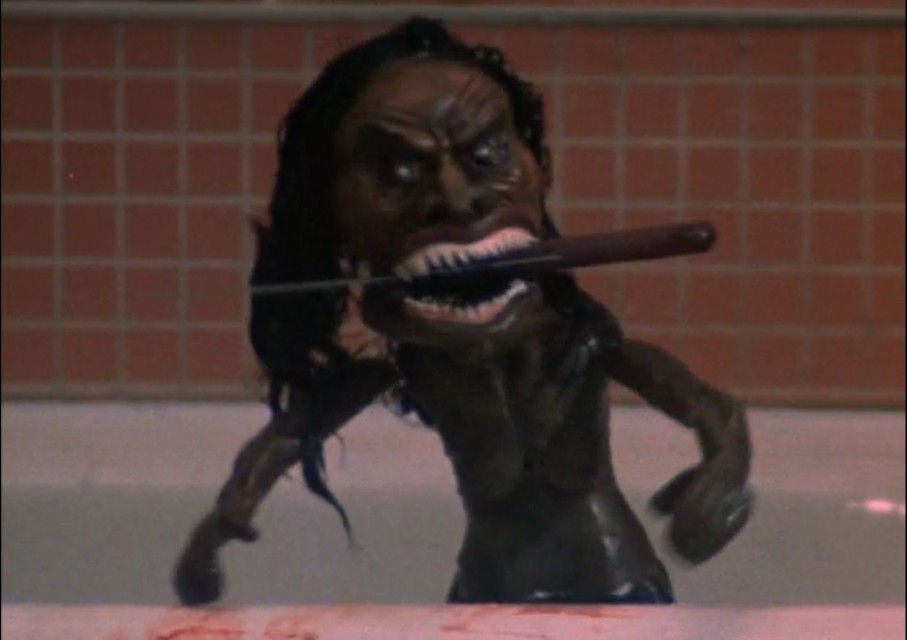
The horror anthology. To begin with these were largely the work of another British company, Amicus Productions, who gave us the most well known, Tales From The Crypt, in 1972. The film contained five short stories based on tales from the horror comic series Tales from the Crypt, The Vault of Horror, and The Haunt of Fear published by EC Comics in the US. Tying the stories together was a wraparound in which the protagonists of all the stories hear them told by a mysterious narrator who at the end informs them that they have died in the manner described in their story and are at the entrance to Hell. Again, there were a few of these anthologies in the early-mid 70s. A very notable one, 1975's Trilogy of Terror, was not an Amicus Productions film at all but was written by an American film and TV producer called Dan Curtis. It has achieved fame for the third of its three stories, Amelia. In this story the titular Amelia buys a grotesque little antique wooden Zuni fetish doll with sharp teeth and a spear for her anthropologist boyfriend. She discovers when she gets home that the doll has a chain around its neck and an accompanying scroll informs her that the chain keeps the spirit of a Zuni hunter named "He Who Kills" safely trapped within the doll. Inevitably the chain falls off and the terrifying little doll spends the rest of the story chasing Amelia around her apartment with a carving knife while babbling incoherently in a high pitched voice. This story was frankly terrifying and enough other people thought so for the story to have a 1996 sequel in the anthology Trilogy of Terror II. (It also spawned a bizarre short 1997 pastiche called Karen Black Like Me, a reference to the actor who played Amelia in the original, about a gay man who gets chased around his apartment by a possessed dildo).
The film director Roger Corman directed eight films based on works by Edgar Allan Poe and mostly starring the wonderful Vincent Price, starting with 1960's House of Usher and finishing with 1964's Tomb of Ligeia. I remember them all fairly clearly but to me the most disturbing was 1962's The Premature Burial. The protagonist's obsession with being buried alive instilled in me I think a similar fear and a claustrophobia generally that it took years to dispel. I particularly remember the horror of the opening scene in which graverobbers open a coffin to find blood and fingernails smeared across the inside of the roof showing that the unfortunate inside had woken up after burial and tried desperately to claw his way out. Corman was also responsible for such gems as The Man With X Ray Eyes in which a scientist invents eyedrops that give him X Ray vision and procedes to start testing them on himself without realising that, horrifically, the effect is cumulative. “If thine eye offends thee, pluck it out! Pluck it out!”
While we're talking about Vincent Price it would be criminal not to mention the Dr Phibes films and The Theatre of Blood. In 1971's The Abominable Dr Phibes Price plays the eponymous doctor who is believed to have died in a high speed car crash after hearing of the death of his beloved wife on an operating table. In fact he has survived the crash and, having decided that his wife's death was due to the incompetence of the clinical team operating on her, decides to get his revenge on them by killing them horribly in ways that reflect the plagues of the Book of Genesis. The way you do. 1973's Theatre of Blood had a similar premise: Price plays a ham Shakespearian actor who is humiliated by a number of theatre critics and decides to get his revenge on them all, this time by killing them in ways drawn from plays by Shakespeare. It's all entertaining gory fun when you watch it now but some of it was enough to give us nightmares at the time
By the time the film ended it would often be midnight or later. I would be desperately hoping that Carl’s grandmother would still be awake at the end of it because she would watch me half the way home. She would stand at her door and I would run the twenty yards or so to the top of Arthur Street where she could still see me before I turned the corner. I would turn and give her a little wave to say that she could go back inside and then, head down, I would run as fast as I could the remaining twenty or thirty yards down a darkened Arthur Street to my front door, hoping that Wolfman or Dr Hyde or the Zuni doll or Dr Phibes would not be in a position to grab me on the way down. Week after week that was the pattern. It seems odd now given my state of film-induced terror that my parents never came up to collect me, but of course back then we had no phone, mobile or otherwise, that I could use to tell them when our film ended.
There was a lot of amazingly good horror out there when I was growing up, as well as a lot of silly stuff. That hasn’t really changed I suppose. Just last night I watched two fairly new horror films of which the first, Primate I thought was silly nonsense and the second, Hokum, really rather good. I used to think that nobody would ever write anything better than those M R James stories but the two scariest ghost stories I have ever read were both published this century – 2011’s Dark Matter by Michelle Paver and 2008’s House Of Lost Souls by F G Cottam.
I suspect that the things we see when we are still young, no matter how tame they may seem when we have grown up a little, are the ones that leave the deepest marks. Back in the late 1960s my parents used to watch a British 'spi-fi' show called Department S, about the adventures of a group of operatives working for a department at Interpol (it was the show that brought Peter Wyngarde to fame as crime-solving fop Jason King). On October 15th 1969 ITV broadcast episode 13 of the show, entitled The Man Who Got A New Face. The episode opens with a man breaking into a house in which another man lies sleeping. The intruder approaches the sleeping man and, without waking him, proceds to glue a clown mask to his face. Fast forward to the following morning; the sleeping man awakes, quickly feels there is something wrong and, approaching a mirror, is horrified to see the clown mask glued in place. He begins to scream and claw at the mask but is unable to remove it. Within a few minutes he suffers a heart attack and falls clearly dead to the floor. At the age of 5 I thought that was the most horrifying thing I had ever seen in a TV programme, and it wasn’t even a horror show. Again, maybe it wasn’t the sort of thing responsible parents should be letting their 5-year old son watch. The point is though that it is our imaginations that construct the terrors that bind us for so long afterwards. I remember nothing more about that episode of Department S and I suspect it wasn’t all that entertaining, but the opening scene will be vivid in my memory until the day I die, even though it was just a balding old guy in a mask.

I’ll always love being terrified though.
Comments